Showing posts with label advocacy. Show all posts

Friday, July 20, 2012

Albert's Reflection from D.C.


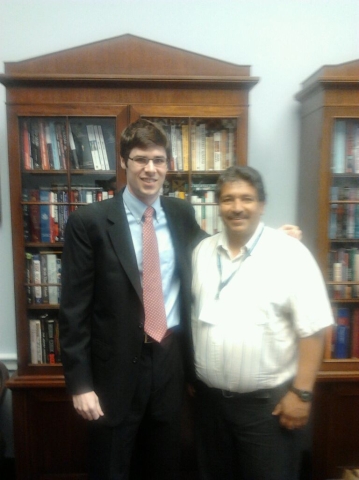
Albert meeting Brian Laughlin, Legislative Assistant to Rep. Jan Schakowski
Prior to going to the National Alliance to End Homelessness conference in Washington, D.C. this week, the only thing I knew about homelessness was how to survive it.

I was curious about where the funding comes from to the agencies that provide services to the homeless. At the conference, I listened to Mark Johnston of the Department of Housing and Urban Development (HUD). He stated that there is a federal goal set to end homelessness for some groups – the chronically homeless and veterans – by the year 2015. I also attended workshops on community-level efforts to end homelessness, partnerships with Child Welfare Services to serve homeless families, and how to help the homeless with substance abuse issues.

The problem I see with the HUD definition of homelessness (which dictates who is eligible for certain programs), is that one has to remain homeless for a long period of time (one year consecutively) to qualify for some services and housing programs. So if a person has been homeless for 11 months while applying for services, under the HUD definition, if he stays with a friend for 2-3 days, then he no longer meets the HUD criteria so he is unable to reap any services that work under that HUD definition.    

What I believe is the greatest idea in working with the homeless is wrap around services: rapid re-housing, rental assistance and comprehensive strategies such as home visits, follow-ups, etc. Unfortunately, as I learned, changes in the Federal, state and city policies relating to homelessness sometimes have an adverse affect on the funding agencies can receive, as well as what services that agency can continue to provide.  
There are unique models and formulas a county, state or city may follow in order to serve and eliminate homeless, but I find them to be too elementary and have discovered that many of them are not helping with their goals to better serve and eliminate homelessness.

Allegheny County, PA spends much of its resources and time with homeless prevention measures. I think that is more effective and makes more sense to do, so that the number of homeless people does not continue to rise. When I was a youth worker, I served youths that were at risk of falling through the cracks and most likely to end up on drugs or in jail. Today, 20 years later, a great majority of those youths are now employed, have stable housing and raising families. Some also have college degrees. Prevention works.

I also had the opportunity to visit the offices of two Illinois legislators – Rep. Jan Schakowsky and Sen. Dick Durbin. Along with representatives from other homeless services agencies, we pressed many concerns. One is to push President Barack Obama to approve a $2.3 billion budget towards serving the homeless and combating homelessness.  Personal testimonies by former homeless adults, including myself, were also given at the meetings.   

In conclusion, I did learn a lot about the topic of homelessness, including but not limited to where agencies receive funding from, and the types of approaches utilized in attempts to curb and/or eliminate homelessness. I don’t think there ever will be one universal formula or model that will eliminate homelessness, as every community, individual and family is unique. With the whole country’s great attempts, I find it very hard to believe that homelessness will end by the year 2015 or 2020 or by any year, but I am encouraged to see the number of advocates, service providers, and even legislators who are doing all they can to alleviate the problem. 
By Albert, LPCS Graduate

Thursday, May 17, 2012

Life as a Case Management Intern


My name is Amy Gillespie and I have been working as a case management intern for the past nine months. I am finishing up my first year of studies for social work and I am extremely grateful that folks at LPCS welcomed a student intern to grow and learn alongside the guests, volunteers, staff, and graduates of LCPS.  Reflecting on my time at Lincoln Park Community Shelter is a challenging and exciting task. I learned so much this year about myself, homelessness, substance abuse and addiction, fundraising, advocacy, and much more. 

Over the past year I have grown immensely in my professional identity, in my confidence, and in my ability to serve men and women who happen to be homeless. I have gone on an emotional journey with the people on my case load and I think I have helped them in some small ways, even if it was simply believing in them and helping them believe more in themselves.  I have grown fond of the people I have worked with--staff, volunteers and guests alike--and I am invested in their successes and struggles.

As I finish up my last couple of weeks at LPCS, I have thought about the things I will miss and the things I will carry with me from LPCS.  I will miss walking into the shelter and saying good morning to the guests and smells of cinnamon rolls wafting from the kitchen from the amazing volunteers who just cooked breakfast. I will miss hearing everyone’s stories that come to LPCS and being blown away and humbled by their incredible resilience in the face of rough times. 

I will also miss working with men and women living on the streets or in emergency shelters through the Community Engagement Program. That is where I felt I could do something immediately helpful for clients that were first hearing about LPCS. They may have come to do laundry, take a shower, have a hot meal, and escape the trials of their lives, but many simply needed to tell their story to a compassionate person. 

The vast majority of the people who happen to be homeless that I have met through my time at LPCS have been older men who are often highly motivated to improve their situation, but stuck in a system that is broken and usually does not give them the time of day. That is why it has also added a layer of reflection and perspective to my experience seeing how passionate and involved the staff, volunteers, graduates, board members and guests are in advocating for larger changes at the systemic level.

I will miss our staff meetings and potluck lunches. I will miss Linda, the Interim Housing Manager’s sassiness, and Betsy and Erin’s banter in staff meetings. I have grown to love everyone I work with and have felt totally embraced and respected as a growing and emerging professional. I will carry with me so many memories of working with guests at LPCS and how their stories have impacted me as a person and as a clinician. I have learned more from them than they probably have learned from me.   

Before I leave, I have been given the task to present recommendations to the staff on changes to one of the programs that serve our guests. I am grateful for the opportunity to contribute in this way. It shows trust and support from them that I have been given a leadership role and it is simply consistent with how I have been treated from the day I stepped inside the door of LPCS. Everyone operates out of a lens of respect for each person’s strengths, gifts and perspectives. There is enormous diversity within the population of the guests at LPCS but it is made most clear that all are welcome and that is a true blessing that LPCS offers those that become involved with the organization. Thank you from the bottom of my heart for welcoming me into such an amazing, textured, and life changing experience and allowing me to work with all of you at LPCS. I won’t forget it and I hope to be back some day in one capacity or another.

Wednesday, July 20, 2011

Educating Our Aldermen

As a community-based agency serving people who have often been disenfranchised, LPCS takes its role as an advocate seriously. We are members of Lakeview Action Coalition, and as such LPCS staff members, guests, and graduates stay involved in systems issues such as affordable housing, access to health care, and livable wage employment.


On Thursday, July 7, I had the privilege of co-moderating the first-ever People’s City Council meeting, organized by LAC and nearly 20 other community groups across the city. The Meeting was a chance to educate our actual City Council (where many members are new) on issues that directly affect our guests.

20 of 50 Alderman attended the meeting, where the “People’s City Council” engaged in a debate about fair jobs, affordable housing, education, and public safety. Over 1,500 people consistently “voted” in favor of creating new revenue streams that will enhance services, establishing accountability for large corporations and banks, and otherwise prioritizing strengthening communities through investing in working class families.

It was an excited and energetic crowd! LPCS guests reported feeling very powerful in influencing our elected officials to act on their behalf. All 20 Alderman signed on in support of our “resolution,” and another 10 have expressed their support since the meeting. Taking part in collective action is just one way that LPCS guests are able to regain control of their lives, re-connect with support systems, and achieve their goals.

For more info about the People’s City Council meeting, check out these links:


 --Erin Ryan, LPCS Executive Director

Thursday, May 26, 2011

It's Awards Season for LPCS!

Staff and Board members accepting the Emergency Fund Award
It's raining awards at LPCS!  This spring, the Lincoln Park Community Shelter has been honored with not one, but two awards!  On May 3rd we were honored with the Emergency Fund Award, which is bestowed to an organization that improves the lives of people in the community we serve.  A few weeks later on May 18th at the annual symposium hosted by North Park University's Axelson Center for Nonprofit Management, the Lincoln Park Community Shelter was honored with the prestigious Alford-Axelson Award for Nonprofit Managerial Excellence! This is a competitive field each year, with previous winners such as The Night Ministry, The Cara Program, and Deborah's Place. The Axelson Award winner was announced at a luncheon honoring the efforts of all of the finalists.  The award was announced via video.  Check it out!


Thursday, March 17, 2011

Experiencing a "Point in Time"

On a clear, chilly, January night, we piled into cars, armed with clipboards, flashlights, boxes of hats and gloves, and questions. Questions for homeless folks we would find on the street about demographics and their various needs.We drove around Chicago, peering out the car windows, searching for people to count and survey for the biannual “Point In Time” info gathering. The U.S. Department of Housing and Urban Development requires all cities seeking federal funding for homeless programs to conduct a count of the homeless population. This will estimate needed allocations for homeless services. Though counterintuitive, we had an incentive to find as many currently homeless people as possible. We wanted to gather the most accurate number, so that homeless folks aren’t “short changed” when it comes to allocating funding for our city. 

I was assigned to a portion of the Lincoln Park neighborhood, along with two other Point In Time volunteers. Dozens of volunteers gathered at headquarters around Chicago, and were dispatched all over the city, with the intent of surveying every square inch. My group and I weaved carefully through the pristine streets of Lincoln Park, filling our map with highlighter marks as we turned each corner. It felt ridiculous to be searching for homeless folks down streets lined with fancy cars perched in front of million dollar homes. I doubted that there would be much tolerance for people to be “loitering” on these streets, and I doubted that people who are homeless would feel comfortable on these streets anyway. Not surprisingly, we found one person; he was speedily wheeling a shopping cart down a busy street and preferred not to be surveyed.

Our count after 4 hours of searching: 1.  

Demographic info collected and warm winter clothing distributed: 0.

This was not what any of us novice Point In Time volunteers expected when we signed up weeks earlier. I had envisioned being on a street such as Lower Wacker, having worthwhile conversations with maybe 25 homeless individuals, collecting valuable info, distributing needed supplies. You know, like how it would be in a movie.

As we are constantly reminded in social service work: there is always more to the story. Are there a number of individuals sleeping outside in Lincoln Park who we missed? When other Northside counting groups reported similarly low numbers, can we be sure that our tally is anywhere near accurate? What made the man we encountered on Clybourn wary of interacting with us? Can he be reached with services? Does he want services? A most interesting question: does he need services? Can it be deduced that folks staying outside on a below zero night in January (presumed to be a time when only the “truly” homeless are out), are challenged with a mental illness? Is enough being done to care for our homeless neighbors? Should we care?
As we drove back to headquarters at 2am, we surmised whether or not we had just done a service or a disservice to the currently and future homeless. This was the major take-away for me. There are people currently feeling snug and secure in their houses who will become homeless. Will Chicago be prepared to serve them? 
 --Katie McNamara, Case Management Intern

Thursday, April 1, 2010

A trip to Springfield

Working in such a hands on environment at the shelter, truly at the grassroots level, is so valuable in terms of understanding the day to day struggles of homelessness. But it’s always important to take a step back and recognize the systemic problems that make homelessness happen. Being in Springfield jolted me back to that reality. It is easy to “blame the victim,” profess that individuals need to pull themselves up by their own bootstraps. But homelessness, at its core, is a musical chairs dilemma. More people than places to sit. This is something that I tried to get across to people I spoke with at the capitol. When I sat down with my state rep, it was apparent that he actually did understand this, that affordable housing is limited. The problem was that he put the burden on the non-profits themselves to find the resources to create all of the housing necessary. The fact that non-profits might not be in the business of MAKING MONEY hadn’t dawned on him. It is important for groups of people to continue reminding our state representatives and senators that fighting homelessness is a struggle that requires the collaboration of non-profits doing on-the-ground work, individuals being empowered to make positive life decisions, AND the government shaping a just and equitable system via their lawmaking.

Being given the brush off by two of my legislators certainly made it clear to me that they are not worried about the homeless population in terms of their ability to shape the next political election. It’s true, persons without a home are much less likely to register to vote, go door to door for candidates, donate to campaigns, and show up at the polls on election day. That’s why it’s important for those of us who DO engage in such political actions to speak out and be the best voice of homeless individuals that we can possibly be. Helping provide day to day services to people in need is something I take pride in. But remembering that shelter guests are a SYMPTOM of the problem, and not the problem itself, is critical. This trip to Springfield helped encourage me to look to legislators in helping ameliorate some of these struggles, as opposed to putting all of the responsibilities on non-profits and the individuals themselves, which I sometimes do. No matter how impressive this shelter is, and no matter how much good work it does, we can’t forget that the buck stops in capitol buildings.
--Katie McNamara, LPCS Volunteer Coordinator, Americorps*VISTA