Friday, July 20, 2012

Albert's Reflection from D.C.


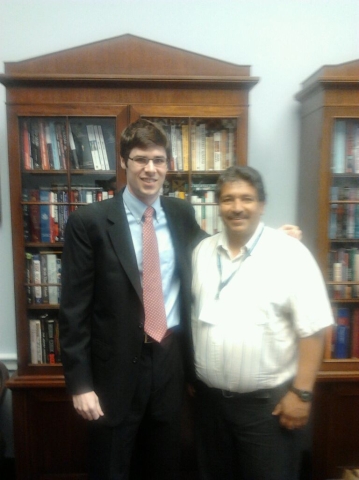
Albert meeting Brian Laughlin, Legislative Assistant to Rep. Jan Schakowski
Prior to going to the National Alliance to End Homelessness conference in Washington, D.C. this week, the only thing I knew about homelessness was how to survive it.

I was curious about where the funding comes from to the agencies that provide services to the homeless. At the conference, I listened to Mark Johnston of the Department of Housing and Urban Development (HUD). He stated that there is a federal goal set to end homelessness for some groups – the chronically homeless and veterans – by the year 2015. I also attended workshops on community-level efforts to end homelessness, partnerships with Child Welfare Services to serve homeless families, and how to help the homeless with substance abuse issues.

The problem I see with the HUD definition of homelessness (which dictates who is eligible for certain programs), is that one has to remain homeless for a long period of time (one year consecutively) to qualify for some services and housing programs. So if a person has been homeless for 11 months while applying for services, under the HUD definition, if he stays with a friend for 2-3 days, then he no longer meets the HUD criteria so he is unable to reap any services that work under that HUD definition.    

What I believe is the greatest idea in working with the homeless is wrap around services: rapid re-housing, rental assistance and comprehensive strategies such as home visits, follow-ups, etc. Unfortunately, as I learned, changes in the Federal, state and city policies relating to homelessness sometimes have an adverse affect on the funding agencies can receive, as well as what services that agency can continue to provide.  
There are unique models and formulas a county, state or city may follow in order to serve and eliminate homeless, but I find them to be too elementary and have discovered that many of them are not helping with their goals to better serve and eliminate homelessness.

Allegheny County, PA spends much of its resources and time with homeless prevention measures. I think that is more effective and makes more sense to do, so that the number of homeless people does not continue to rise. When I was a youth worker, I served youths that were at risk of falling through the cracks and most likely to end up on drugs or in jail. Today, 20 years later, a great majority of those youths are now employed, have stable housing and raising families. Some also have college degrees. Prevention works.

I also had the opportunity to visit the offices of two Illinois legislators – Rep. Jan Schakowsky and Sen. Dick Durbin. Along with representatives from other homeless services agencies, we pressed many concerns. One is to push President Barack Obama to approve a $2.3 billion budget towards serving the homeless and combating homelessness.  Personal testimonies by former homeless adults, including myself, were also given at the meetings.   

In conclusion, I did learn a lot about the topic of homelessness, including but not limited to where agencies receive funding from, and the types of approaches utilized in attempts to curb and/or eliminate homelessness. I don’t think there ever will be one universal formula or model that will eliminate homelessness, as every community, individual and family is unique. With the whole country’s great attempts, I find it very hard to believe that homelessness will end by the year 2015 or 2020 or by any year, but I am encouraged to see the number of advocates, service providers, and even legislators who are doing all they can to alleviate the problem. 
By Albert, LPCS Graduate

Thursday, July 12, 2012

Meet Jack


Jack came to LPCS after years of suffering from mental illness and substance abuse.  He had, in fact, stayed at the LPCS before.  When he returned this time, he was already engaged in outpatient substance abuse treatment with the assistance of a case manager’s referral while he was on the waiting list. Jack successfully completed treatment while a guest of LPCS.

Jack knew that he wanted to go back to working either in sales, where he has extensive experience, or in a new trade.  He identified, however, that this time he wanted to make sure that he was ready to work so that the same pattern of substance abuse and missing work due to mental health symptoms did not occur again.  While staying at the LPCS, he was referred to mental health treatment, where he worked with an individual therapist and in group therapy to develop more understanding of his illness, and develop healthy coping skills.  

Jack was able to establish a period of mental health stability and recovery from substance abuse while at LPCS. With his therapist’s agreement, one he decided he had reached a desired level of stability in which he would be able to handle on the job stressors, Jack turned his focus to employment.  He worked diligently to update his resume and cover letters and began applying for jobs. Jack was accepted into an IT job training program, which he completed successfully. The same week Jack completed his job training, he was also able to move into his new subsidized apartment.  He was also immediately offered work through the agency where he completed job training.  The stars seemed to align at the same time for Jack.

Jack reports that he loves his new home.  He focuses on his health, walking around his neighborhood every evening after work, and enjoying life.  As Jack continues to work, he utilizes the skills for a healthy life that he built upon while staying at LPCS. 

 By: Brianne Spresser
LPCS Case Manager

Thursday, July 5, 2012

History of Volunteerism in America


America is cherished for many things, not least of which is the country’s capacity to step up and help each other during historical times of need. Many organizations find themselves with a surplus of volunteers, calling in every day with the hopes of spending their time helping a cause. Even here at the Lincoln Park Community Shelter, I am in awe of how dedicated our volunteers are, even on holidays. This tradition goes back much further than the shelter. In fact, America may not even be a free country today if it were not for the tradition of Volunteerism. Perhaps I should explain…

 As the earliest pioneers came to America, they found themselves without supplies or a structured governmental support system. Colonists understood that “togetherness” was crucial to their survival. They formed support systems to help each other with farming tasks and household necessities. They nursed one another when people were sick to overcome illnesses that were new to them. This time period marks the beginning of dedicated volunteer work.

            In the 18th century, Benjamin Franklin (a personal favorite) founded the first volunteer firehouse, a tradition that still exists today in many small towns. He is also responsible for our library system, encouraging people to bring finished books to his home so that he could redistribute and share knowledge. Imagine living in a world where you couldn’t share e-books through multiple readers! The 1700s also brought the Revolutionary War, in which people raised funds to support the war efforts and would boycott any British goods (tea party, anyone?).

            By the 19th century, America experienced a rejuvenation of religious fervor with the Great Awakening. Churches would have youth outreach programs and they would house the homeless. Many organizations formed during this time that still exist today, such as the YMCA, which emerged on a Michigan college campus, the American Red Cross in 1881, and the United Way. During the Civil War, many women spent time sewing supplies for soldiers and families in need. War has shown to be an important time in which people step up to help one another.

            By the 20th century, America was no stranger to volunteering. The country had a great deal of practice, and just in time, because by the 1930s America was experiencing the Great Depression. It was during this decade that the first soup kitchen emerged to feed and shelter people and breadlines were created to help fulfill basic necessities. People were no longer giving and volunteering based on religious fervor. Some mainstream organizations that emerged were the Rotary Club in 1910, the Lions Club and Kiwanis in 1920.

            By 1930, Roosevelt began the first wave of environmentalism (that’s right, long before Al Gore brought An Inconvenient Truth to theaters). The Conservation Corps began in the 1930s and has since been planting over 3 million trees a decade!

            World War II had civilians supporting servicemen from home and also encouraged women to do many of the jobs previously reserved for men. During the 60s, a liberal movement began against poverty, inequality, and violence. Lyndon B. Johnson called it the “War on Poverty” in 1967. The Peace Corps was soon after created. Today, more than 2 million people each year are served by volunteers. Volunteerism is one of America’s largest human service organizations.

Discussion –
Hope that you enjoyed this trip through the history of volunteerism – please share where you think America will go from here? How does volunteering shape our country today and what can we expect for the future?

 By: Meghan Freebeck

Thursday, June 28, 2012

Free People, No Homes


The New Jim Crow by Michelle Alexander

Who is more blameworthy: the young black kid who hustles on the street corner, selling weed to help his momma pay the rent? Or the college kid who deals drugs out of his dorm room so that he’ll have cash to finance his spring break? (Alexander 216)

In an attempt to better understand our guests, community, and the world, the staff at LPCS has developed a monthly book club. This past month the staff attempted to grasp the significance of “The New Jim Crow: Mass Incarceration in the Age of Colorblindness” by Michelle Alexander.

First question on the table was: who managed to finish the book? This New York Times Bestseller is over 200 heavy pages challenging the racism that exists from America’s neighborhood policing up through to the 14th Amendment. While many people considered the election of Barack Obama an end to racism, Alexander proposes that we have not yet entered an era of colorblindness, but rather redistributed racism back into the justice system.

There were many interesting points of conversation that occurred after reading the book. Murray pointed out how, when it comes to drug related crimes, it is interesting that there is no actual victim. No one is actually calling the police to report a crime because both parties involved (the dealer and the purchaser) is willing participants. After the emergence of the War of Drugs, police learned new tactics of finding criminals and then prosecuting them without a crime actually being reported.

Once arrested, few drug related crimes actually go to trial. Some people will remain in jail for a significant amount of time. Others will plead guilty because they will have charges stacked on top of themselves and do not have the resources for a strong lawyer. Odds are rarely in the favor of the person arrested, so a plea bargain is often the only way out.

It is important to always consider how these concepts relate to the guests at LPCS. Alexander pointed out how difficult it is for a person to get a home once they have been arrested for anything, even if it occurred decades ago. A person that felt obligated to plead guilty to a charge from over 15 years ago is often going to find him or herself without a home or job because many places will not take anyone with a record. “Throughout the United States, public housing agencies have adopted exclusionary policies that deny eligibility to applicants even with the most minor criminal backgrounds” (Alexander 145). Job applications will also weed out all of the people that have a background. Even if a person chooses to decline to answer, that often sends a red flag up to the employer or landlord.

So, what can be done to rehabilitate someone who has done their time but is out of options now that they are a free person again? We were not able to come up with any realistic solutions, only frustrations. Can you think of any ways around this system?

Respond with your thoughts and suggestions below -
  

Thursday, June 21, 2012

Welcome, Meghan Freebeck


Before joining the Lincoln Park Community Shelter, I studied English and History at the University of Wisconsin – Madison. I later attended DePaul University, where I received a Masters Degree in English. Upon completing my Masters Degree, I began work as the Director of Communications for The Shakespeare Project of Chicago, a non-profit theatre that brings the words of William Shakespeare to life with free performances and dramatic readings throughout the city. At the same time, I was teaching English Composition at Harper College and Morton College.
My relationship with the Lincoln Park Community Shelter unofficially began in January, 2012, when I attended an orientation to become a volunteer. I was so eager to be a part of this incredible organization that I checked nearly every volunteer opportunity box. I began by cooking dinners at the Shelter with a group of friends, later I contributed by bringing in sack lunches. The very dedicated Volunteer Coordinator extraordinaire, Elli Krandall, suggested that I use my editing experiences to help guests with their cover letters. I took her recommendation and began coming to the Shelter every other Tuesday to help guests write and edit their cover letters.
During one of these visits, I only had one guest sign up to meet with me and discuss his cover letter. I asked him what it was about his job experiences that he wanted to express or further convey in his cover letter. His answer: “Why I came to be living here today”. This is when it occurred to me that the LPCS did more than just give a rooftop, job assistance, and food to 35 homeless men and women. The LPCS was giving 35 individuals a chance to tell and change their stories. Each person that stays at the LPCS found themselves without homes for vastly different reasons; however, their goals are the same. I realized, then, that I wanted to have a more active role in changing the stories of these men and women. It is for these reasons that I am thrilled to accept the position as the Community Relations Manager at the Lincoln Park Community Shelter.  
 --Meghan Freebeck, Community Relations Manager

Thursday, June 7, 2012

Land of the Lost Souls


There are many reasons I enjoy working at the Lincoln Park Community Shelter, but I think they all stem from one of our founding philosophies: community. A lot of effort is put into creating community between guests, between guests and staff, between guests and volunteers, between staff and volunteers, and between staff. Sometimes this is facilitated very intentionally, through things such as Community Meetings, where all of the guests come together to talk about the shelter and what things they can do or change to help each other through this transitional time in their lives. Other times this is done more organically, through the informal conversations between people in the kitchen or community room throughout the day.

One of the intentional ways in which the staff not only works to build community with themselves, but also works to better their understandings of the guests and their varied situations, is through our staff Book Club. Beginning this year, we have read books focused on alcoholism, suicide, and homelessness.

The last book we read was Land of the Lost Souls: My Life on the Streets, by Cadillac Man, which chronicles some of his time experiencing homelessness in New York City. The book was interesting in almost an infinite number of ways, but there were some things that stood out most, and were a big part of the discussion we had.

One of the main questions we had was about Cadillac Man's transition from being housed to homeless. He tells readers that before "Cadillac Man" started living on the streets, he lived in a home with his wife and daughter. He had a steady job at a meat market, but when things went under, he was eventually let go. His wife started working, and was supporting them both. He believed that his wife was ashamed of him, and thus, he was ashamed of himself. He acknowledges that he could have gotten a part-time or low paying job, such as working at McDonald’s or Burger King, but that he felt it would have been equally shameful.  Eventually he decided he didn’t deserve to stay, and he left. Since the book is written entirely from his perspective, we all wondered what factors other than shame contributed to his leaving. Was he depressed or experiencing some other type of mental health issue? Did his wife want him to leave, or was that just his interpretation of the situation? It is hard to say what really happened.

We also discussed how intelligent and resourceful Cadillac Man is throughout the book. He talks about the ways he stays warm in the winter (by stuffing newspaper and napkins into his clothing, to create insulation), the various first aid items he has (bandages and antiseptic), and how he earns money (through canning – recycling cans and bottles) and keeps it safe.

A big question we had in relation to our work at LPCS was whether or not Cadillac Man would utilize any of the services we offer. In the book he mentions taking sandwiches from an organization outside of a church, and the importance and rarity of showers, so we think that maybe he would attend our Saturday morning Community Engagement Program (CEP), for a hot breakfast, laundry, and a shower. We do not, however, think he would be interested in moving into LPCS and looking for a stable housing solution. A common theme throughout the book is his belief that he deserves to live on the streets and does not deserve a real home. That belief is one of the reasons why we questioned whether or not he was dealing with a mental illness, such as depression.

Overall, we all really enjoyed the book and the opportunity it gave us to understand another person’s situation. No matter how many people you meet or how many stories you learn, each person’s experience with homelessness is different, and the more you hear, the more you understand that. I would definitely suggest this book for anyone looking to gain more perspectives on homelessness and for a new way to engage with the issue.

If you are interested in seeing what other books are on the staff book club list, check out our Cause Reading List board on Pinterest (Note: you do not have to have a Pinterest account to be able to view).

--Elli Krandel, Volunteer Coordinator