 |
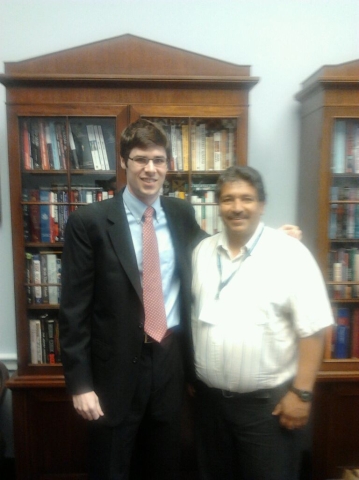
| Albert meeting Brian Laughlin, Legislative Assistant to Rep. Jan Schakowski |
Prior to going to the National Alliance to End Homelessness
conference in Washington, D.C. this week, the only thing I knew about homelessness
was how to survive it.
I was curious about where the funding comes from to
the agencies that provide services to the homeless. At the conference, I
listened to Mark Johnston of the Department of Housing and Urban Development
(HUD). He stated that there is a federal goal set to end homelessness for some
groups – the chronically homeless and veterans – by the year 2015. I also
attended workshops on community-level efforts to end homelessness, partnerships
with Child Welfare Services to serve homeless families, and how to help the
homeless with substance abuse issues.
The problem I see with the HUD definition of
homelessness (which dictates who is eligible for certain programs), is that one
has to remain homeless for a long period of time (one year consecutively) to
qualify for some services and housing programs. So if a person has been
homeless for 11 months while applying for services, under the HUD definition,
if he stays with a friend for 2-3 days, then he no longer meets the HUD
criteria so he is unable to reap any services that work under that HUD definition.
What I believe is the greatest idea in working with
the homeless is wrap around services: rapid re-housing, rental assistance and
comprehensive strategies such as home visits, follow-ups, etc. Unfortunately,
as I learned, changes in the Federal, state and city policies relating to
homelessness sometimes have an adverse affect on the funding agencies can
receive, as well as what services that agency can continue to provide.
There are unique models and formulas a county, state
or city may follow in order to serve and eliminate homeless, but I find them to
be too elementary and have discovered that many of them are not helping with
their goals to better serve and eliminate homelessness.
Allegheny County, PA spends much of its resources
and time with homeless prevention measures. I think that is more effective and
makes more sense to do, so that the number of homeless people does not continue
to rise. When I was a youth worker, I served youths that were at risk of
falling through the cracks and most likely to end up on drugs or in jail.
Today, 20 years later, a great majority of those youths are now employed, have
stable housing and raising families. Some also have college degrees. Prevention
works.
I also had the opportunity to visit the offices of
two Illinois legislators – Rep. Jan Schakowsky and Sen. Dick Durbin. Along with
representatives from other homeless services agencies, we pressed many
concerns. One is to push President Barack Obama to approve a $2.3 billion
budget towards serving the homeless and combating homelessness. Personal testimonies by former homeless
adults, including myself, were also given at the meetings.
In conclusion, I did learn a lot about the topic of
homelessness, including but not limited to where agencies receive funding from,
and the types of approaches utilized in attempts to curb and/or eliminate homelessness. I don’t think there ever will be one
universal formula or model that will eliminate homelessness, as every community,
individual and family is unique. With the whole country’s great attempts, I
find it very hard to believe that homelessness will end by the year 2015 or
2020 or by any year, but I am encouraged to see the number of advocates,
service providers, and even legislators who are doing all they can to alleviate
the problem.
By Albert, LPCS Graduate