Showing posts with label homelessness. Show all posts

Friday, July 20, 2012

Albert's Reflection from D.C.


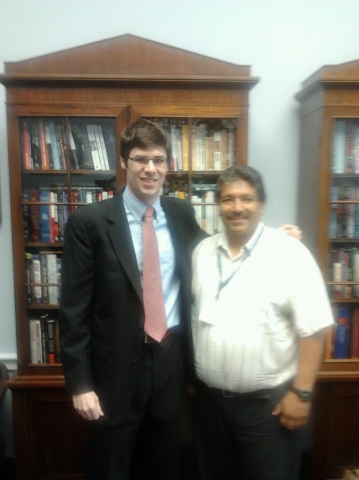
Albert meeting Brian Laughlin, Legislative Assistant to Rep. Jan Schakowski
Prior to going to the National Alliance to End Homelessness conference in Washington, D.C. this week, the only thing I knew about homelessness was how to survive it.

I was curious about where the funding comes from to the agencies that provide services to the homeless. At the conference, I listened to Mark Johnston of the Department of Housing and Urban Development (HUD). He stated that there is a federal goal set to end homelessness for some groups – the chronically homeless and veterans – by the year 2015. I also attended workshops on community-level efforts to end homelessness, partnerships with Child Welfare Services to serve homeless families, and how to help the homeless with substance abuse issues.

The problem I see with the HUD definition of homelessness (which dictates who is eligible for certain programs), is that one has to remain homeless for a long period of time (one year consecutively) to qualify for some services and housing programs. So if a person has been homeless for 11 months while applying for services, under the HUD definition, if he stays with a friend for 2-3 days, then he no longer meets the HUD criteria so he is unable to reap any services that work under that HUD definition.    

What I believe is the greatest idea in working with the homeless is wrap around services: rapid re-housing, rental assistance and comprehensive strategies such as home visits, follow-ups, etc. Unfortunately, as I learned, changes in the Federal, state and city policies relating to homelessness sometimes have an adverse affect on the funding agencies can receive, as well as what services that agency can continue to provide.  
There are unique models and formulas a county, state or city may follow in order to serve and eliminate homeless, but I find them to be too elementary and have discovered that many of them are not helping with their goals to better serve and eliminate homelessness.

Allegheny County, PA spends much of its resources and time with homeless prevention measures. I think that is more effective and makes more sense to do, so that the number of homeless people does not continue to rise. When I was a youth worker, I served youths that were at risk of falling through the cracks and most likely to end up on drugs or in jail. Today, 20 years later, a great majority of those youths are now employed, have stable housing and raising families. Some also have college degrees. Prevention works.

I also had the opportunity to visit the offices of two Illinois legislators – Rep. Jan Schakowsky and Sen. Dick Durbin. Along with representatives from other homeless services agencies, we pressed many concerns. One is to push President Barack Obama to approve a $2.3 billion budget towards serving the homeless and combating homelessness.  Personal testimonies by former homeless adults, including myself, were also given at the meetings.   

In conclusion, I did learn a lot about the topic of homelessness, including but not limited to where agencies receive funding from, and the types of approaches utilized in attempts to curb and/or eliminate homelessness. I don’t think there ever will be one universal formula or model that will eliminate homelessness, as every community, individual and family is unique. With the whole country’s great attempts, I find it very hard to believe that homelessness will end by the year 2015 or 2020 or by any year, but I am encouraged to see the number of advocates, service providers, and even legislators who are doing all they can to alleviate the problem. 
By Albert, LPCS Graduate

Thursday, June 7, 2012

Land of the Lost Souls


There are many reasons I enjoy working at the Lincoln Park Community Shelter, but I think they all stem from one of our founding philosophies: community. A lot of effort is put into creating community between guests, between guests and staff, between guests and volunteers, between staff and volunteers, and between staff. Sometimes this is facilitated very intentionally, through things such as Community Meetings, where all of the guests come together to talk about the shelter and what things they can do or change to help each other through this transitional time in their lives. Other times this is done more organically, through the informal conversations between people in the kitchen or community room throughout the day.

One of the intentional ways in which the staff not only works to build community with themselves, but also works to better their understandings of the guests and their varied situations, is through our staff Book Club. Beginning this year, we have read books focused on alcoholism, suicide, and homelessness.

The last book we read was Land of the Lost Souls: My Life on the Streets, by Cadillac Man, which chronicles some of his time experiencing homelessness in New York City. The book was interesting in almost an infinite number of ways, but there were some things that stood out most, and were a big part of the discussion we had.

One of the main questions we had was about Cadillac Man's transition from being housed to homeless. He tells readers that before "Cadillac Man" started living on the streets, he lived in a home with his wife and daughter. He had a steady job at a meat market, but when things went under, he was eventually let go. His wife started working, and was supporting them both. He believed that his wife was ashamed of him, and thus, he was ashamed of himself. He acknowledges that he could have gotten a part-time or low paying job, such as working at McDonald’s or Burger King, but that he felt it would have been equally shameful.  Eventually he decided he didn’t deserve to stay, and he left. Since the book is written entirely from his perspective, we all wondered what factors other than shame contributed to his leaving. Was he depressed or experiencing some other type of mental health issue? Did his wife want him to leave, or was that just his interpretation of the situation? It is hard to say what really happened.

We also discussed how intelligent and resourceful Cadillac Man is throughout the book. He talks about the ways he stays warm in the winter (by stuffing newspaper and napkins into his clothing, to create insulation), the various first aid items he has (bandages and antiseptic), and how he earns money (through canning – recycling cans and bottles) and keeps it safe.

A big question we had in relation to our work at LPCS was whether or not Cadillac Man would utilize any of the services we offer. In the book he mentions taking sandwiches from an organization outside of a church, and the importance and rarity of showers, so we think that maybe he would attend our Saturday morning Community Engagement Program (CEP), for a hot breakfast, laundry, and a shower. We do not, however, think he would be interested in moving into LPCS and looking for a stable housing solution. A common theme throughout the book is his belief that he deserves to live on the streets and does not deserve a real home. That belief is one of the reasons why we questioned whether or not he was dealing with a mental illness, such as depression.

Overall, we all really enjoyed the book and the opportunity it gave us to understand another person’s situation. No matter how many people you meet or how many stories you learn, each person’s experience with homelessness is different, and the more you hear, the more you understand that. I would definitely suggest this book for anyone looking to gain more perspectives on homelessness and for a new way to engage with the issue.

If you are interested in seeing what other books are on the staff book club list, check out our Cause Reading List board on Pinterest (Note: you do not have to have a Pinterest account to be able to view).

--Elli Krandel, Volunteer Coordinator

Thursday, May 17, 2012

Life as a Case Management Intern


My name is Amy Gillespie and I have been working as a case management intern for the past nine months. I am finishing up my first year of studies for social work and I am extremely grateful that folks at LPCS welcomed a student intern to grow and learn alongside the guests, volunteers, staff, and graduates of LCPS.  Reflecting on my time at Lincoln Park Community Shelter is a challenging and exciting task. I learned so much this year about myself, homelessness, substance abuse and addiction, fundraising, advocacy, and much more. 

Over the past year I have grown immensely in my professional identity, in my confidence, and in my ability to serve men and women who happen to be homeless. I have gone on an emotional journey with the people on my case load and I think I have helped them in some small ways, even if it was simply believing in them and helping them believe more in themselves.  I have grown fond of the people I have worked with--staff, volunteers and guests alike--and I am invested in their successes and struggles.

As I finish up my last couple of weeks at LPCS, I have thought about the things I will miss and the things I will carry with me from LPCS.  I will miss walking into the shelter and saying good morning to the guests and smells of cinnamon rolls wafting from the kitchen from the amazing volunteers who just cooked breakfast. I will miss hearing everyone’s stories that come to LPCS and being blown away and humbled by their incredible resilience in the face of rough times. 

I will also miss working with men and women living on the streets or in emergency shelters through the Community Engagement Program. That is where I felt I could do something immediately helpful for clients that were first hearing about LPCS. They may have come to do laundry, take a shower, have a hot meal, and escape the trials of their lives, but many simply needed to tell their story to a compassionate person. 

The vast majority of the people who happen to be homeless that I have met through my time at LPCS have been older men who are often highly motivated to improve their situation, but stuck in a system that is broken and usually does not give them the time of day. That is why it has also added a layer of reflection and perspective to my experience seeing how passionate and involved the staff, volunteers, graduates, board members and guests are in advocating for larger changes at the systemic level.

I will miss our staff meetings and potluck lunches. I will miss Linda, the Interim Housing Manager’s sassiness, and Betsy and Erin’s banter in staff meetings. I have grown to love everyone I work with and have felt totally embraced and respected as a growing and emerging professional. I will carry with me so many memories of working with guests at LPCS and how their stories have impacted me as a person and as a clinician. I have learned more from them than they probably have learned from me.   

Before I leave, I have been given the task to present recommendations to the staff on changes to one of the programs that serve our guests. I am grateful for the opportunity to contribute in this way. It shows trust and support from them that I have been given a leadership role and it is simply consistent with how I have been treated from the day I stepped inside the door of LPCS. Everyone operates out of a lens of respect for each person’s strengths, gifts and perspectives. There is enormous diversity within the population of the guests at LPCS but it is made most clear that all are welcome and that is a true blessing that LPCS offers those that become involved with the organization. Thank you from the bottom of my heart for welcoming me into such an amazing, textured, and life changing experience and allowing me to work with all of you at LPCS. I won’t forget it and I hope to be back some day in one capacity or another.

Monday, March 19, 2012

Rock On WXRT!


Yesterday, a few of us from the Lincoln Park Community Shelter had the privilege of visiting the WXRT studios for a tour, and to pick up the check from the sales of the ONXRT Live from the Archives Vol. 13 CD.  We didn't know exactly how much to expect, but the final amount exceeded our wildest expectations--$25,000!  

What impressed me more than the gold records or autographed concert posters on the walls (Wilco, anyone?), was the enthusiasm of everyone we met there.  The staff were very gracious and had kind things to say about the work that we do.  The WXRT staff told us that LPCS was chosen as the local recipient of the sales because they want to have the money raised make an impact in the local community (there is also a global or national partner each year).  They also recognize that because we are a small organization, the funds raised from the sales of the CDs will really have an impact on what the organization is able to do.  

Thank you WXRT for supporting the work that we do, and helping keep Chicago a vibrant (or should I say rockin'!) community!

--Heather Pressman, Community Relations Manager

Thursday, February 23, 2012

Happy Anniversary LPCS!

On Sunday, February 12th, the Lincoln Park Community Shelter celebrated its 27th anniversary.  The idea for a neighborhood shelter was first formed when a group of Lincoln Park neighbors got together to discuss a way they could help the homeless in their community.  On a cold February night in 1985, the Lincoln Park Community Shelter opened the doors to its first homeless guests.  With the help of four neighborhood churches, the Lincoln Park Community Shelter was born and we have been serving the greater Chicago area ever since.  The LPCS is not religiously affiliated and continues to be completely privately funded.  Truly a community based organization, the LPCS is volunteer-driven with over 1,500 volunteers helping to serve as meals, providing overnight supervision, delivering programs, and more each year. 

While we wish that there were no need for LPCS to exist anymore, we are grateful for all of the support we have received from the community over the past 27 years.  Without your support we wouldn’t be the successful organization that we are today.  So thanks, and here’s hoping that we won’t have to celebrate another 27 years!

To learn more about the history of LPCS, click here. Read about our 25th anniversary celebration here. 

Want to learn more about volunteering?  See what opportunities are available here.


Thursday, February 2, 2012

Meet an LPCS Graduate!


We love to share to good news when someone graduates from LPCS.  Here is the story of one individual who graduated recently:

Lisa*, in her mid-60’s, came to the United States almost three years ago. After looking for work on East Coast, she moved to Chicago where she thought her employment opportunities would be greater.  However, she was not able to obtain employment here and became homeless, entering LPCS.  Lisa worked diligently in job training programs and in computer classes to increase her employment skills but was never able successfully land a job.  In addition to working towards her goals, Lisa became very involved in doing volunteer work at two local churches.  This summer, Lisa became very ill and spent several weeks in the hospital.  After her release she needed frequent treatments on an outpatient basis.  Since she still needed an intensive level of medical intervention while she recovered, which could not be provided at LPCS, Lisa initially went from the hospital directly to Interfaith House, a shelter for people with substantial medical needs and who are homeless.  Her case manager at LPCS kept in close contact with the social workers at Interfaith to make sure that her transition back to LPCS went as smoothly as possible.  Shortly after her return to LPCS this fall, she was informed that an apartment was available for her in a permanent supported housing program.  She now has her own apartment in Edgewater and has maintained many contacts through her church activities, as well at LPCS.  She has gotten a clean bill of health from her physicians and is very happily living in the community once again.

*name changed to protect identity

Thursday, December 29, 2011

What will you change in 2012?

This is the time of year when people reflect back on the year that is about to pass, and look forward to the year to come.  This is also the time when many people make New Year's resolutions.  Most of these resolutions involve one thing--change.  We asked guests to share their resolutions, or plans for change, for 2012.  Not surprisingly, many of the things that made the list are shared by people all over: to cut back or stop smoking, eat better, lose weight, to be a better person, to be more patient.  Reducing the amount of time on Facebook also made the list.  Resolving not to make resolutions also appeared.  Many guests' goals, however, exhibit a fierce determination.  More than one person responded that they will work harder to get a job and housing.  My favorite response to the question of "what will you change in 2012?"--"my address." 

Thursday, December 15, 2011

New Experiences

We love it when volunteers share their experiences of volunteering at LPCS.  We recently received an article written about a Wisconsin youth group's trip to Chicago and wanted to share it with you.  Enjoy!

If you walked into the Lincoln Park Community Shelter in Chicago, IL on July 31, you would have seen 15 people from Menomonie's First Congregational United Church of Christ.  Kids and adults alike would be found playing games, preparing a supper, and laughing with the guests in the homeless shelter. 

The group of 6 adults and 9 youth left on Friday, July 29, for a long, long drive down to the Windy City.  Upon arriving, the group stayed at St. Pauls United Church of Christ in the Lincoln Park area.  Three teams prepared tow breakfasts, two dinners, and three bunches of sack lunches over the course of three days.  The preparation entailed planning, shoppiung for, cooking, and plating and serving each meal.

This was the first mission trip for many of the youth, and it really showed them that not everybody has a place to come home to every night.  The Lincoln Park Community Shelter is a facility in the Lincoln Park neighborhood that provides housing and meals for 35 homeless people.  Because it's privately funded, the guests, as they are called, can stay as long as they need to.  Some of the men and women staying at the shelter have jobs or are going to school and are making the transition into permanent housing, which is the goal of the program.  When they leave, a spot opens up and a new person comes into the shelter.  Alumni of LPCS (Graduates) often volunteer once they have left, creating a cycle of good-deed doing. 

The experience was a new one for the youth.  "It really made me realize that people on the street sometimes have good skills and just need some help to get into a shelter and have a better life," saus Sean Williams who went on the trip with his father Todd and his younger brother Max.  Rachel Ropella says, "Going to Chicago truly opened my eyes about how I see poverty and how much of a difference serving them with a smile makes."

Fifteen adults and youth returned Tuesday, August 2, with a new way pf perceiving the world.  Everyone had a great time, as is evidenced by their blog: uccchicagomissiontrip.blogspot.com.  For more information about the trip, contact First Congregational UCC at 715-235-5838.
--Emily Billingsley, First Congregational UCC

Friday, October 7, 2011

What are you doing for World Homeless Action Day?


Monday, October 10th will be the second annual World Homeless Action Day. In Chicago alone there are over 21,000 homeless individuals on a given night. Anyone can become homeless and stereotypes need to be replaced with accurate information. Most guests at the shelter never expected to be homeless. They previously had jobs and housing and just need assistance accessing resources so they can get back on their feet.

With millions of people around the world dealing with homelessness, it is clear that this is an issue that needs attention and that is exactly what the day was created to do. One of the co-founders, Brianna Karp, was in her early twenties when she lost her job and became homeless. While still homeless she became an advocate for other homeless people and started World Homeless Action Day as an opportunity for members of all communities to get involved. Hers is truly an inspirational story.

How can you observe World Homeless Action Day? You can respond to homelessness locally, by getting involved at a community shelter or outreach center and by using the day as a platform to speak out about the needs of the homeless. Since it is only the second year of this day of observance, its existence is not yet widely known. For this reason, it is more important than ever for us to share this information with others to allow for continued expansion of participation from organizations and community members. It also means we need to be creative in developing collaborative methods for observing this day. Homelessness can end, but only with community-wide involvement.

Friday, September 16, 2011

A New Journey


As the new Program Intern at LPCS, I would like to take a moment to introduce myself and to express my gratitude to the guests, staff, and volunteers for welcoming me so graciously into the LPCS family. My name is Keri Arnholz. I currently reside on the North side of Chicago. I am a social work graduate student at the University of Illinois at Chicago, with a concentration in Community Health and Urban Development. I have joined LPCS for my final year in grad school.

After almost six years working in social services, I remain committed as ever to issues of social justice, including homelessness and poverty. My previous experience in acute & long-term inpatient settings has helped me become more aware of the importance of community-based organizations in promoting long-term self-sufficiency and a greater quality of life. As a proponent of empowerment practice, it has been exciting to see how this concept is truly present throughout all programs, activities, and day-to-day interactions at LPCS. It has also been exciting to witness an interim housing model, including wrap-around services after learning about the increased emphasis on its importance in combating homelessness. LPCS embodies all of the major components of the interim housing model in a way that I never imagined I would find.

It is my honor to be a part of this organization. I look forward to learning from the insight and knowledge of staff, volunteers, and guests, as well as utilizing my experience to contribute to the LPCS mission.

Thank you!

Keri

Thursday, August 25, 2011

Goodbye, Katie!

After two years at LPCS, Katie McNamara is moving on to another organization.  She wanted to take the time to say "Goodbye and thank you LPCS guests, volunteers, and staff!" 

When I was a junior in high school, our Humanities teacher gave us the homework assignment to: Intentionally put yourself in a new and uncomfortable position for a day and report back. My friend and I decided to “be homeless for a day”. We went to the thrift store and bought “homeless looking” clothes, allocated only enough money for the train ride from the suburbs into Chicago, left our wallets at home, perched ourselves in front of the train station at Madison and Canal, and begged for change so that we could get back home at the end of the day and maybe get a bite to eat. Looking back, I realize how ghastly naive this was, but I see what my 16 year old self was trying to accomplish. I was searching for some kind of understanding around what it meant to be homeless; what was the day to day experience of these mysterious folks I saw on the streets of Chicago?; is it easy to be homeless?; is it hard?; what are these people like?; should I feel bad for them?; should I help them?

Now, almost 10 years later, and having worked at the Lincoln Park Community Shelter for two years, these answers are coming into focus. Mostly, the answer is “it depends.” It’s no surprise that this is not something one can discover from a one day high school homework project, in which we received an A for effort and an F at “being homeless.” These days, as a graduate student receiving a Master of Arts in Social Work and taking on the role of Case Manager at LPCS, my “assignments” are more sophisticated, but sometimes still as uncomfortable and new. There are serious emotional, physical, financial, and spiritual challenges that our guests face; however, the most surprising aspect of my time at LPCS was that, despite the heart-wrenching stories that come through the door, it is generally a happy, loose, comfortable place to be. I’ve appreciated that our On Track Program sticks to the philosophy of empowering homeless individuals to make life changes; this fosters an environment where the infamous “burn out” of social service providers is largely avoided. LPCS was also a wonderful place to be because of our volunteers. As Volunteer Coordinator, I would often say that opening up my work email absolutely restored my faith in humanity. It was consistently filled with messages from enthusiastic, creative people asking how they can help out.

My next position will be as a social work intern at the Jesse Brown Veterans Administration Medical Center in their Addiction Treatment Program. It is frightening sometimes to consider the countless new challenges I will face in this and future jobs. However, I am comforted by my firm confidence that there is nowhere else I would have rather begun my career than at LPCS. Thank you LPCS guests, volunteers, and staff for an unforgettable learning experience.

--Katie McNamara, Case Manager and former Volunteer Coordinator

Thursday, August 18, 2011

A little bit of inspiration...

Every day while working at the LPCS, I am reminded of the reasons I’m here. Beyond the desire to assist people as they improve their lives and end their homeless situation, the guests I work with constantly inspire me with they way they are making progress.

Like many guests, Dee has overcome some odds to improve herself.  She recognizes the need to take the steps to get to where she wants to be, even though a leap or jump is preferable.  We referred Dee to the CARA Program for job readiness and job training, where she has excelled in the classroom and in self discovery.  At the CARA program, the class participates in daily inspiration, where someone will share about themselves with the group.  One of these inspiring assignments was to write a letter to yourself.  Here is what Dee wrote:

“Dear Dee,

Guess what girl, I just love you.  You have really made me proud.  You have [come] a long way. You have really shown me that if you put your mind on something that Dee wants to do, that she can accomplish it.  When you said that you [were] going to quit using drugs, you succeeded, regardless of how you did it. No only that, you also stopped smoking cigarettes. Dee, where things went wrong and you thought there wasn’t hope, you stuck in there and you never gave up, even when you had to move from staying with your significant other because he left you after you had been in a 25 year relationship. I thought you were not going to make it, just coming out of recovery.  After the death of mother and grandmother, you’re still keeping your feet on the right path. After staying with daughter did not work out, Dee, you know that you are a strong lady.  Girl, you just don’t know how strong and determined you are....

Dee, I love you just for who you are. I even love you for making a change in your life. Staying at a shelter is a big step, but you have to start somewhere to get somewhere.  All you have to do is to get out of your own way and do the right thing....

Dee, I am proud of you.  Now you are at this program called CARA, and you have been staying motivated. You have been transformed all over again.  Girl, you make me want to cry everyday because I see you doing something positive with your life.”


Dee's story serves as inspiration not only to herself, but to those around her.  Keep up the good work, Dee.  It will all pay off in the end!
--Brianne Spresser, Case Manager

Thursday, August 11, 2011

Community Impact

Working the morning Interim Housing shift often includes interacting with breakfast volunteers.  On several occasions this summer, high school youth groups participating in short term mission trips cooked and served breakfast.  The students are often timid and unsure of what to expect at a homeless shelter, but eventually realize that homeless adults aren’t so scary, and most are even willing to have a conversation similar to any other adults with whom they interact.

I was once one of those students, later an adult chaperon, away for a week with my church youth group, trying to see what impact I could make.  These experiences are often eye opening and challenging.  They also create lifetime memories and change one’s heart.
When someone asks what my “life changing event” was, or why I want to work at a homeless shelter, I think of one such trip to New York while I was in college.  One of the ministries during the week was to cook food at the facility where we stayed, and bring it to Tompkins Park (of RENT fame) along with clothing to pass out.  Hanging out with homeless people who slept in the park sure was intimidating, until I discovered that as humans, we are all able to connect and to learn from each other.  Seeing the effects of systems of oppression in that park, I began to feel like this one week wasn’t enough for me.  I began to feel as though focusing on social justice would be my life’s work.
Fast forward 10 years.  I have been working at the Lincoln Park Community Shelter for almost a year now through Lutheran Volunteer Corps (LVC).  LVC’s core values include Community, Simplicity/Sustainability, and Social Justice.  My job placement with the LPCS is primarily the social justice function, by walking alongside and finding ways to empower individuals to make life changes. 

I also see the other two core values of LVC reflected at work.  This interim housing shelter is a community of adults working to better themselves and each other, existing within and being supported by the community in Lincoln Park.  My experience living in an intentional community as part of LVC has allowed me a bit of understanding about community living within a shelter: it is challenging, and requires both patience and compromise. At the LPCS we encourage guests to learn about “Living Green,” while we also try to reduce environmental impacts (sustainability) and well as unnecessary spending (simplicity). 
I’ve found that the little things make an impact.  Maybe you have the time and resources to cook a hot breakfast and eat alongside the people for whom you cooked.  Maybe you can share your skills through teaching a class. Perhaps you have some household goods that someone who finally has their own space could use in their new home.  For some of us it’s a week long mission trip to serve, or a year long volunteer commitment; at the LPCS, our daily mission is serving and walking with fellow members of our community.

--Brianne Spresser, LVC, Case Manager